
Research
My research is in nonlinear dynamics and chaos, spanning low-dimensional Hamiltonian systems, the characterization of chaos, and the collective behavior of coupled systems and complex networks. Below is an overview of the main lines, each with representative publications.
Synchronization, chimeras, and complex networks
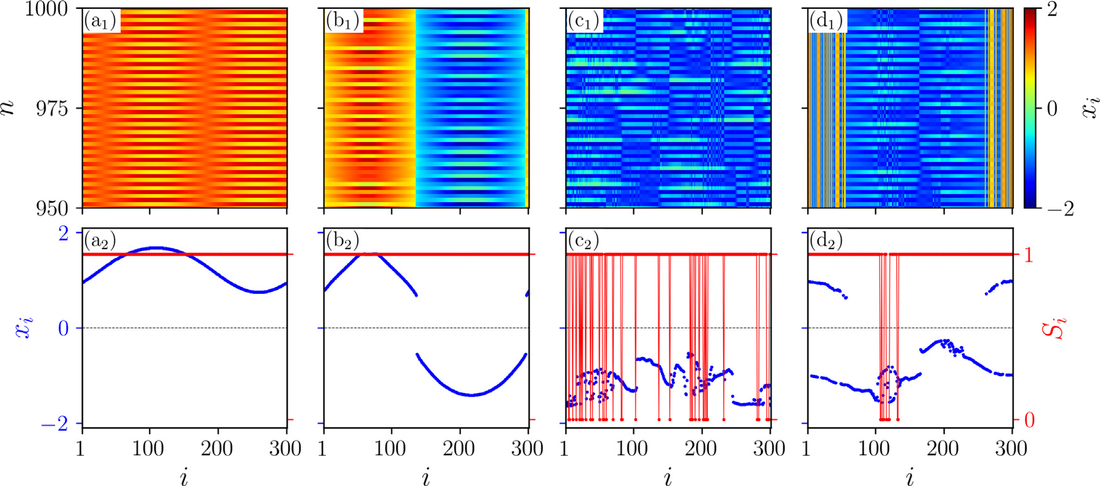
I study the collective dynamics of coupled oscillators and complex networks, including synchronization, chimera-like coherence and incoherence patterns, and networks whose connectivity evolves in time. In adaptive networks, together with S. Yanchuk and J. Kurths at the Potsdam Institute for Climate Impact Research (PIK), we have identified a new phenomenon, recurrent chaotic clustering and slow chaos, in which the slow adaptation of the network structure is chaotic while the fast dynamics of the nodes remain regular, producing long intervals of frequency-clustered dynamics interrupted by fast jumps between them. Representative works: Recurrent chaotic clustering and slow chaos in adaptive networks, Identification of single- and double-well coherence-incoherence patterns by the binary distance matrix, Extended networks as a route of stabilization of divergent dynamics, Pattern formation in symplectic coupled map lattices.
This line also reaches into biomedical applications: in collaboration with a physician and a biologist, we have used complex-network analysis to study the pathophysiology of HER2-positive breast cancer, with a focus on the role of matrix metalloproteinases, Time to focus again on matrix metalloproteinases?.
Transport and diffusion in Hamiltonian systems
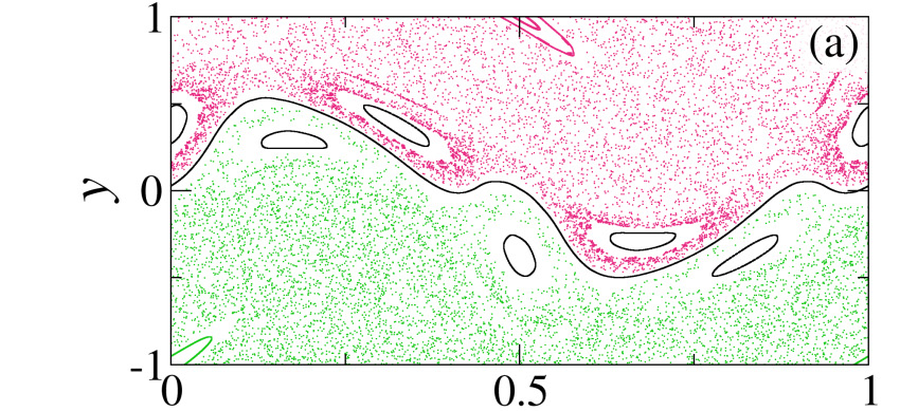
This line concerns the transport and diffusion of chaotic trajectories in nonlinear Hamiltonian systems, a large part of it in nontwist maps. I have worked on transport mechanisms and barriers, ratchet currents, the role of invariant manifolds in transport, and the stickiness and escape of chaotic orbits. Representative works: Unpredictability in Hamiltonian systems with a hierarchical phase space, Ratchet current and scaling properties in a nontwist mapping, Transport mechanisms associated with non-integer wavenumbers in a discontinuous nontwist map, Hierarchical fragmentation of regular islands in a discontinuous nontwist map, Role of manifolds in the transport of chaotic trajectories in the standard nontwist map, and Chaotic escape of impurities and sticky orbits in toroidal plasmas.
Chaos indicators and recurrence-based methods
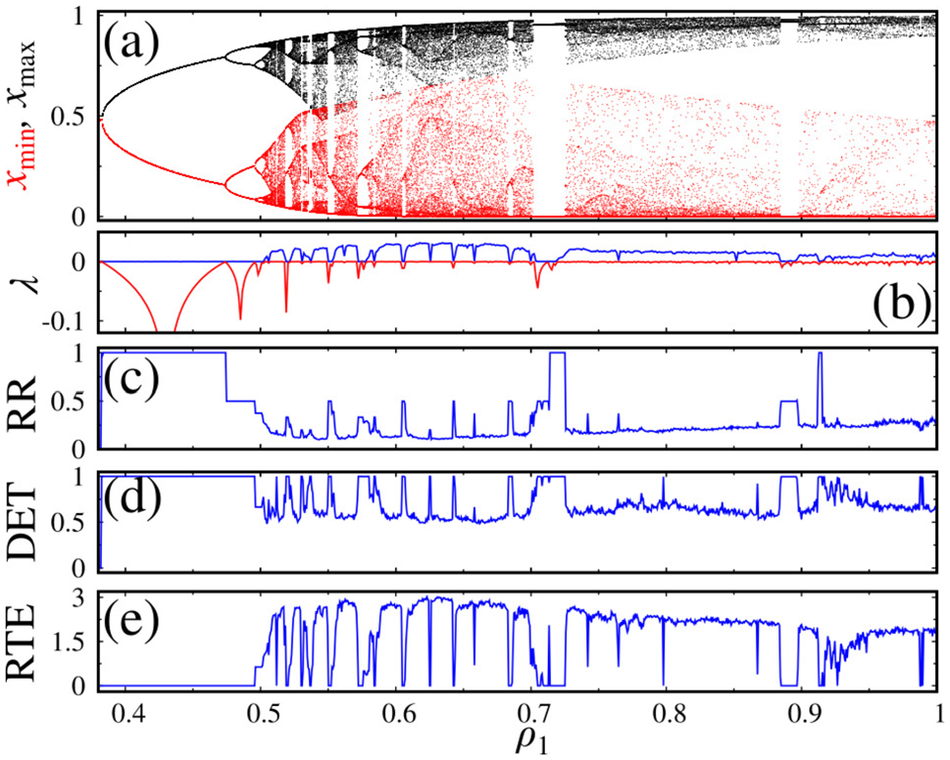
I develop and apply quantitative indicators to distinguish regular from chaotic motion and to measure the strength of chaos. This includes recurrence-based methods, in particular the recurrence time entropy as a measure of stickiness, together with alignment indices such as the SALI, the GALI, and the linear dependence index. Representative works: Stickiness and recurrence plots: an entropy-based approach, On the behavior of Linear Dependence, Smaller, and Generalized Alignment Indices in discrete and continuous chaotic systems, and Characterizing and quantifying weak chaos in fractional dynamics.
Classical billiards
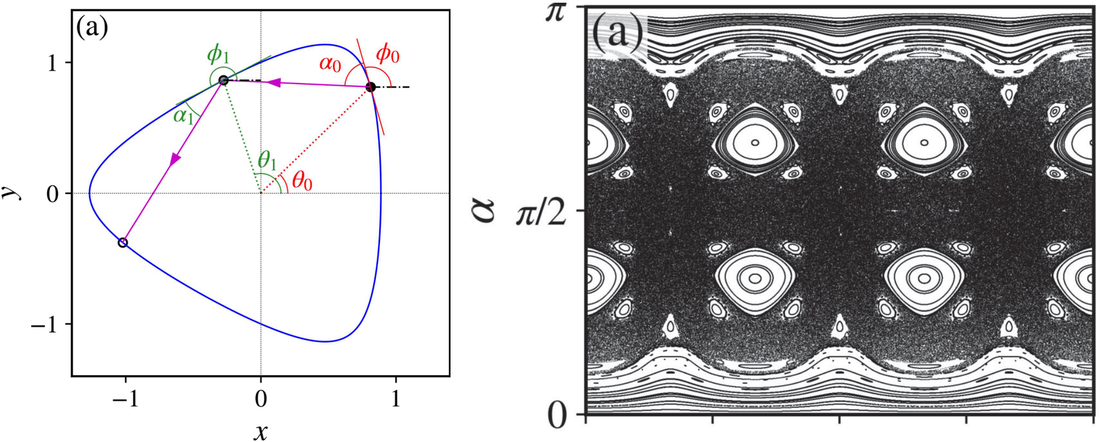
Billiards are a canonical setting for classical chaos, where the geometry of the boundary alone determines whether the motion is regular, mixed, or fully chaotic. My work here concerns the phase-space structure, bifurcations, and the escape and scaling properties of billiards with tunable geometry. Representative works: Conservative generalized bifurcation diagrams and phase space properties for oval-like billiards, Dynamical properties for a tunable circular to polygonal billiard, and An investigation of escape and scaling properties of a billiard system.
Open source software
A common thread across these lines is the development of quantitative tools for characterizing complex dynamics, which I make openly available through pynamicalsys. A full list of publications is on the publications page.